How Local Businesses Should Prepare for AI Search: A 30 Day Action Plan
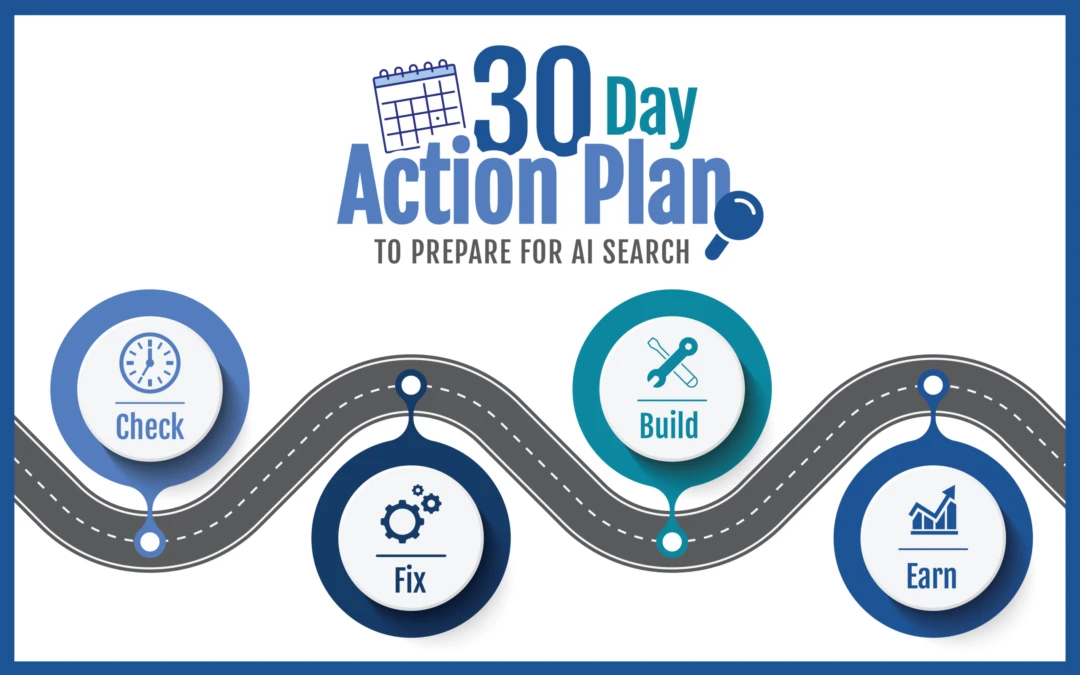
In our last two posts we covered where AI fits into marketing and SEM, and why you want your business showing up in tools like ChatGPT, Gemini, and Perplexity. Now let’s cover what to actually do to get your business in these AI overviews. This post presents a 30 day action plan that any local business owner can follow to start appearing in AI search results.
Before you start: 10 minute Quick Check
You can’t measure progress without benchmarks to compare against. Before you start making edits, do a quick search in ChatGPT, Perplexity, and Google. Ask each one the question that your ideal customer would ask. For example, a used car dealer customer might search “where can I find a reliable used car under $15,000 in central NY?” You’ll want to write down whether your business gets mentioned. If you get mentioned, write down what it says about you. If you don’t get mentioned, write down who it mentioned instead and what it says about them. Save these so you have benchmarks for these searches, and then repeat every 30 days to monitor progress.
This baseline tells you where you and your competitors stand today, and whether you are making progress.
Week 1: Fix what AI search tools see first
As mentioned in our last post, AI looks for information on your business from other sources across the web. If those sources have incorrect or outdated information, the AI can get confused and decide to skip mentioning you. To fix this you need to ensure consistency everywhere your business appears. Here are the major places to tackle:
- Google Business Profile: Confirm your hours, phone number, name, address, website, and business category are accurate. Place 5-10 photos of your storefront or your services, and write a clean description with phrases that customers use.
- NAP Consistency: Make sure your name, address, and phone number (NAP) are accurate and consistent across Yelp, Bing Places, Facebook, BBB, and any other directories your business would appear in.
- Homepage Schema Markup: Add local business schema to your homepage. If you don’t know what this means, contact your sites web developer and send them this message: “Please add LocalBusiness schema markup with our name, address, phone number, hours, and service area to the homepage.” They should be able to make that edit the same day, if not within the hour.
Week 2: Build the content that AI search likes to quote from
AI often pulls language directly from web pages. Therefore, your website should have pages that clearly answer the specific questions your customers are asking. Your homepage and service pages are not the best places for that. You need to build question-answer content. Here’s how:
- Pick five real questions your customers are asking: Don’t pick what you think they might ask. Pull questions from your emails, service requests, voicemails and sales calls. These should be questions like: “how long will an oil change take?”, “how much does it cost for you to diagnose my furnace not heating?”, or “do you landscape for commercial properties, or only residential?”
- Write one short answer per question: Two to four sentences max. Make it direct and conversational, just like you would actually answer a customers question on the phone.
- Add them to your site as an FAQ section: A dedicated FAQ page is best, but you can also place smaller FAQ sections on your homepage and service pages as well. Wrap them in FAQ schema (your developer knows what this means). Do not skip this as it is an important step for AI to read your site.
Week 3: Earn third-party validation
At this point you have cleaned up what you say about your business. Now it is time to get others to talk about your business. Here are three quick steps to earn some third party validation:
- Ask for three reviews: Pick three customers from the last 60 days who were happy with your product or service. Send a personal text or email with a direct link to your Google review page. You earn bonus points for following up to their review with a positive response.
- Get one local mention: You want an article, newsletter, or listing that will link back to your site. Any legitimate, locally relevant mention with a link back to your site counts. Try pitching an article to a local newspaper or join a Chamber Of Commerce. Donate to a community event or foundation, or sponsor a youth sports team. It all counts.
- Claim or update one industry specific listing: For example, cars.com for auto dealers or Angi for home services. AI heavily weights these third party sources.
Week 4: Measure, document, and repeat
Run your 10 minute check again from day one and see if anything has changed. Ask the exact same question to ChatGPT, Perplexity, and Google. Compare the results to what you wrote down in your benchmarks. You can also check your web analytics and Google Search Console for any new referral traffic from AI sources. Expect to see minor increases at first, but progress is progress. You can also check for increases in your branded search terms. If more people are searching for your brand than before, and you have not made significant changes elsewhere, that is a good signal of increased AI traffic as well.
Lastly, double down on what appears to be working. If you see increased traffic from ChatGPT and your Yelp listing, start driving more reviews there. If you see more traffic from your Google Business Profile and to your FAQ page, then get more reviews and answer more questions.
What this plan won’t do
This plan will not get you mentioned by every AI tool overnight. AI optimization is still in its early days, and may take 6 to 12 months of consistent effort. Following this plan will set a strong foundation for your business to start picking up AI traffic, and keep you ahead of the competition not doing the work.
If you want help running this plan for your business, or would like a partner who can handle the technical pieces while you focus on running your company, the TOTAL Advertising team is ready to help.
Book a free consultation with TOTAL Advertising here.
Written by
Amari Williams, Senior Search Marketing Specialist